Ask the source. Sourcerer answers questions about your code so you can understand it from first principles.
Get trusted answers from the source. Sourcerer indexes snapshots of git repos so that AI agents can search the code, generate authoritative answers, and provide inline citations for verification. It ships with configurations for Elastic Agent Builder, which searches your code in Elasticsearch the way a coding agent would search it on a filesystem. Its value shines for questions that span multiple repos or versions: Sourcerer will find the right snapshot and grep a billion lines of code in seconds.
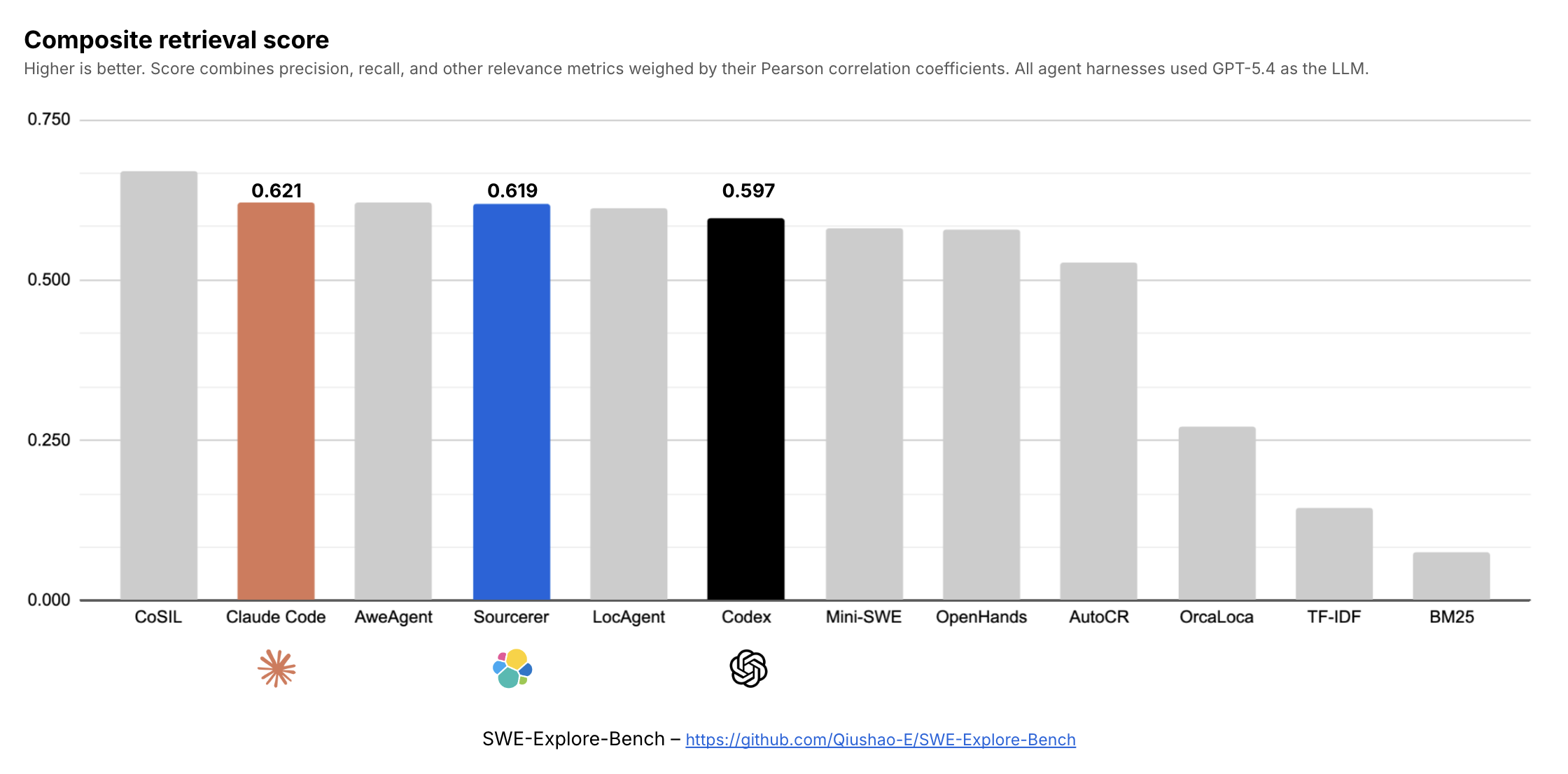
Search like a coding agent at scale. Sourcerer is statistically tied with frontier coding agents for code retrieval based on its results from SWE-Explore-Bench (see chart below). You can expect Sourcerer to search your code as well as any coding agent, while scaling across many historical repository snapshots as if it was a single repo.
Code is the source of truth for its own behavior. Always authoriative, never outdated. While documentation and tribal knowledge offers context, they can never be the primary source of truth for its implementation.
Go with the grain on how model are trained. LLMs used by coding agents are trained to use terminal commands, and grep has worked exceptionally well. Sourcerer searches code with the same semantics (e.g. grep, ls, cat, head, tail) over multiple code repositories indexed in Elasticsearch for greater speed, scale, relevance, security, collaboration, and customization.
Make sure you have uv and git on your machine, and Elasticsearch and Kibana running somewhere.
- Install the
sourcererCLI:uv tool install "git+https://github.com/elastic/sourcerer.git@v2.0.1" - Add connection details. Create a
.envin your working directory, then fill it in:cat > .env <<'EOF' ELASTICSEARCH_URL= KIBANA_URL= # Authentication (use either API Key or both of Username and Password) ELASTICSEARCH_API_KEY= #ELASTICSEARCH_USERNAME= #ELASTICSEARCH_PASSWORD= EOF
- Define the sources to index. Create
sourcerer.yml, then edit it according to thesourcerer.ymlspecification:Each source is scoped to acat > sourcerer.yml <<'EOF' sources: # Example: Index and retain only the latest snapshot of the "main" branch - git: { host: "github", org: "elastic", repo: "docs-content", ref_type: "branch" } match: "main" retain.count: 1 # Example: Index and retain only the latest patch release snapshot of every minor release for the last two major releases - git: { host: "github", org: "elastic", repo: "elasticsearch", ref_type: "tag" } match: "v{major}.{minor}.{patch}" since.ref: "v8.17.0" retain.version: { majors: 2, patches: 1 } EOF
git.host,git.org,git.repo, andgit.ref_type(can betag,branch, orcommit).matchdefines the names of tags, branches, or commit hashes to index based on a pattern likev{major}.{minor}.{patch}or a fixed string likemain.sincedefines where to begin indexing in the commit history.retaindefines how long to keep indexed refs before they qualify for pruning. - Set up the indices and agent:
sourcerer setup --config sourcerer.yml - Index the repos:
sourcerer index --config sourcerer.yml - Chat about your software with the Sourcerer agent in Kibana under "Agents".
The sourcerer.yml specification has the full reference of fields supported by the configuration file.
By default, sourcerer clones repos using HTTPS. You can override this in sourcerer.yml by setting the urls.clone of a Git host to an SSH-compatible URL template.
Example sourcerer.yml override for GitHub:
hosts:
- id: github
  urls.clone: "git@github.com:{git.org}/{git.repo}.git"
Example sourcerer.yml overrides for built-in Git hosts:
hosts:

# Bitbucket
- id: bitbucket
  urls.clone: "git@bitbucket.org:{git.org}/{git.repo}.git"

# Codeberg
- id: codeberg
  urls.clone: "git@codeberg.org:{git.org}/{git.repo}.git"

# Forgejo
- id: forgejo
  urls.clone: "git@code.forgejo.org:{git.org}/{git.repo}.git"

# GCP Cloud Source
- id: gcp-cloud-source
  urls.clone: "ssh://source.developers.google.com:2022/p/{git.org}/r/{git.repo}"

# Gitea
- id: gitea
  urls.clone: "git@gitea.com:{git.org}/{git.repo}.git"

# GitHub
- id: github
  urls.clone: "git@github.com:{git.org}/{git.repo}.git"

# GitLab
- id: gitlab
  urls.clone: "git@gitlab.com:{git.org}/{git.repo}.git"

# Launchpad
- id: launchpad
  urls.clone: "git+ssh://git.launchpad.net/{git.repo}"

# SourceHut
- id: sourcehut
  urls.clone: "git@git.sr.ht:~{git.org}/{git.repo}"
AWS CodeCommit, Azure DevOps, and Google Secure Source Manager (SSM) require
non-standard fields beyond git.org and git.repo to properly namespace code.
Therefore you must define them by hand in sourcerer.yml under hosts.
Example sourcerer.yml for AWS CodeCommit, Azure DevOps, and GCP Secure Source Manager using HTTPS URLs for clones:
hosts:

# AWS CodeCommit
# Note: Replace REGION by hand.
- id: aws-codecommit-REGION
  urls:
   clone: "https://git-codecommit.REGION.amazonaws.com/v1/repos/{git.repo}"
   directory: "https://console.aws.amazon.com/codesuite/codecommit/repositories/{git.repo}/browse/{git.commit}/--/{file.directory}"
   file: "https://console.aws.amazon.com/codesuite/codecommit/repositories/{git.repo}/browse/{git.commit}/--/{file.path}"
   line: "https://console.aws.amazon.com/codesuite/codecommit/repositories/{git.repo}/browse/{git.commit}/--/{file.path}?lines={line.number}"
   line_range: "https://console.aws.amazon.com/codesuite/codecommit/repositories/{git.repo}/browse/{git.commit}/--/{file.path}?lines={line.number_start}-{line.number_end}"

# Azure DevOps
# Note: Replace PROJECT by hand.
# Note: Untested
- id: azure-devops-PROJECT
  urls:
   clone: "https://dev.azure.com/{git.org}/PROJECT/_git/{git.repo}"
   directory: "https://dev.azure.com/{git.org}/PROJECT/_git/{git.repo}?path=/{file.directory}&version=GC{git.commit}"
   file: "https://dev.azure.com/{git.org}/PROJECT/_git/{git.repo}?path=/{file.path}&version=GC{git.commit}"
   line: "https://dev.azure.com/{git.org}/PROJECT/_git/{git.repo}?path=/{file.path}&version=GC{git.commit}&line={line.number}&lineEnd={line.number_plus_one}&lineStartColumn=1&lineEndColumn=1&lineStyle=plain"
   line_range: "https://dev.azure.com/{git.org}/PROJECT/_git/{git.repo}?path=/{file.path}&version=GC{git.commit}&line={line.number_start}&lineEnd={line.number_end_plus_one}&lineStartColumn=1&lineEndColumn=1&lineStyle=plain"

# GCP Secure Source Manager
# Note: Replace INSTANCE_ID, PROJECT_NUMBER, and LOCATION by hand in all places.
# Note: Untested
- id: gcp-ssm-INSTANCE_ID-PROJECT_NUMBER
  urls:
   clone: "https://INSTANCE_ID-PROJECT_NUMBER-git.sourcemanager.dev/{git.org}/{git.repo}.git"
   directory: "https://INSTANCE_ID-PROJECT_NUMBER.LOCATION.sourcemanager.dev/{git.org}/{git.repo}/src/commit/{git.commit}/{file.directory}"
   file: "https://INSTANCE_ID-PROJECT_NUMBER.LOCATION.sourcemanager.dev/{git.org}/{git.repo}/src/commit/{git.commit}/{file.path}"
   line: "https://INSTANCE_ID-PROJECT_NUMBER.LOCATION.sourcemanager.dev/{git.org}/{git.repo}/src/commit/{git.commit}/{file.path}#L{line.number}"
   line_range: "https://INSTANCE_ID-PROJECT_NUMBER.LOCATION.sourcemanager.dev/{git.org}/{git.repo}/src/commit/{git.commit}/{file.path}#L{line.number_start}-L{line.number_end}"
Use these values for urls.clone if you prefer to use SSH for clones:
- AWS CodeCommit:
"ssh://git-codecommit.REGION.amazonaws.com/v1/repos/{git.repo}" - Azure DevOps:
"git@ssh.dev.azure.com:v3/{git.org}/PROJECT/{git.repo}" - Google SSM:
"ssh://INSTANCE_ID-PROJECT_NUMBER-git.sourcemanager.dev/{git.org}/{git.repo}.git"
sourcerer must be able to run these git commands, which requires its shell environment to have persistent, non-interactive authentication configured for your remote Git hosts:
| Git host | Authentication guide |
|---|---|
| AWS CodeCommit | ssh, https, git-remote-codecommit |
| Azure DevOps | ssh, https |
| Bitbucket | ssh, https |
| Codeberg | ssh, https |
| GCP Cloud Source | ssh, https |
| GCP Secure Source Manager | ssh, https |
| GitHub | ssh, https |
| GitLab | ssh, https |
| Gitea | ssh, https |
| Forgejo | ssh, https |
| Launchpad | ssh, https |
| SourceHut | ssh |
To upgrade, reinstall from the desired release tag, replacing v2.0.1 with the release you want:
uv tool install --reinstall "git+https://github.com/elastic/sourcerer.git@v2.0.1"Git tag installations remain pinned to that release. uv tool upgrade sourcerer does not automatically discover a newer GitHub tag.
Sourcerer includes a benchmark harness that measure how well the agent locates the right
source code for a task. The current benchmark, swe_explore_bench
(SWE-Explore-Bench), scores
whether, given an issue, the agent cites the correct file regions.
List what's available:
sourcerer benchmark listRun a benchmark in three steps (from a directory with a .env, as in the
Quickstart):
- Download and build the dataset into
./benchmarks/<name>/(needsgit,uv, and network access to GitHub + HuggingFace):sourcerer benchmark get swe_explore_bench
- Index the benchmark's base commits into Elasticsearch (uses the benchmark's
packaged
repos.yml):sourcerer benchmark index swe_explore_bench
- Run the eval against the Sourcerer agent (needs
KIBANA_URLandELASTICSEARCH_API_KEY):sourcerer benchmark run swe_explore_bench
Useful run options: -k/--top-k (comma-separated cutoffs, e.g. -k 5,10,20;
default 5), -j/--concurrency (instances explored in parallel; default 1),
--connector-id (pick the Agent Builder LLM connector), and --resume (skip
instances already completed). run will download the dataset automatically if
step 1 was skipped.
Each run writes to a timestamped directory:
./benchmarks/<name>/results/sourcerer-<YYYYMMDDHHMMSS>/
├── top5.jsonl      # one file per --top-k value: per-instance regions + metrics
└── traces.jsonl    # full request/response trace for every instance
Aggregate metric averages for each top_k also print to the console when the run
finishes.
To run the CLI from a local checkout without installing it globally, use uv run from
the repo root. uv reads pyproject.toml, provisions a matching Python, and syncs the
dependencies into an isolated ./.venv (gitignored) on first run:
uv run sourcerer help
uv run sourcerer setup
uv run sourcerer index elastic/elasticsearch -b main
uv run sourcerer index --config sourcerer.yml
The project is installed in editable mode, so edits under src/ take effect immediately -
no reinstall needed. Because the environment is isolated in ./.venv, this never conflicts
with a globally installed sourcerer (e.g. from uv tool install).
Equivalently, you can invoke the module directly: uv run python -m sourcerer.cli <command>.
uv run pytest tests/The version in pyproject.toml is the source of truth. Prepare a release through
a normal pull request:
- Run
uv version <major>.<minor>.<patch>(without thevprefix). - Review and commit the resulting
pyproject.tomlanduv.lockchanges. - Merge the pull request to
mainafter its tests pass.
From an up-to-date main with no tracked changes, publish the corresponding tag:
./scripts/release.sh v2.0.1The script requires a strict vMAJOR.MINOR.PATCH tag, verifies that it matches
pyproject.toml, confirms that main matches origin/main and that the tag is
new, checks the lockfile, runs the tests, and builds the package. After
confirmation, it creates and pushes an annotated tag. The tag-triggered GitHub
Actions workflow repeats the checks and creates the GitHub release only if they
pass.